
BANDCAM LOCAL MUSIC HERO
Mason Reed Will Not Roll Over
♱✮♱Tim’s Tavern has been evicted, cited, un-permitted, flooded, and stripped of its sign by the wind. Its owner answered by taking on a second venue and starting a nonprofit. Somebody check this man’s pulse. It’s a kick drum.♱✮♱
Start with the ledger, because it’s absurd. Since moving Tim’s Tavern to White Center, Mason Reed has learned that the stage he bought the place for was never permitted, fielded roughly a hundred noise complaints in a single year, spent six figures dragging the music indoors to keep the peace, and then been told the outdoor stage had to come down anyway. A sewer pipe collapsed. The wind took his sign. And this July, both of his venues lost money putting on shows.
His response was to take over a second music venue and launch a 501(c)(3). We’ll get there.
The road in
Reed spent nine years on the road as a singer-songwriter, playing 250 shows a year and putting 550,000 miles on the odometer. The first Seattle stage he ever played as a touring act was Slim’s Last Chance. File that away.
At the end of 2016 he and fellow musician Matt “Matto” O’Toole bought Tim’s Tavern, a little room at 602 N 105th in Greenwood that had been pouring beer since the 1930s. They put live music on every night, rock to folk to jazz to experimental, with cheap tacos on Tuesdays, and TIM came to stand for Together In Music. The kind of room where a band plays its third show ever to nine people, and one of the nine ends up booking their tenth.
Then the world closed
The doors shut on March 15, 2020. Reed kept paying rent, seventeen months of it, on a bar he wasn’t allowed to open. When Tim’s cautiously reopened in summer 2021, the landlord announced he no longer wanted live music in the space. Greenwood poured its last pint on August 23, 2021.
Then came a year and a half of searching, during which Reed paid the bills cooking backstage for headliners at the region’s biggest venues. He and O’Toole told their realtor exactly what they wanted: something like Drunky’s in White Center, the barbecue joint with the outdoor stage. They got Drunky’s itself. Tim’s reopened in the old Drunky Two Shoes at 9655 16th Ave SW in March 2023, with two stages and an Airstream bar out back, the neon sign from 105th hung inside, and a menu Reed built himself, down to a separate fryer so the vegan nuggets never touch chicken grease. He didn’t just move the bar to White Center; he moved himself there too, a few blocks away.
The stage that wasn’t there
The catch: on paper, the stage didn’t exist. Neither did the patio or the Airstream. All of it, Reed later learned, had been built by a prior tenant without permits and out of code. Six outdoor shows a week drew about a hundred complaints in the first year, and it emerged that downtown White Center’s zoning bars outdoor music venues without a special permit, a detail nobody raised during the years Drunky’s ran the same stage. On February 1, 2024, King County’s permitting division cited Tim’s for operating an “outdoor performance center” without permits. Bundled in were landscaping, grading and building-code violations that predated Reed entirely.
Reed did what a good neighbor does. Outdoor music stopped at 10 p.m. Then, in February 2025, he moved the stage indoors altogether, a renovation that ran past $100,000. The county’s reply was more hoops. One option it presented was returning the patio to its original use: a parking lot.
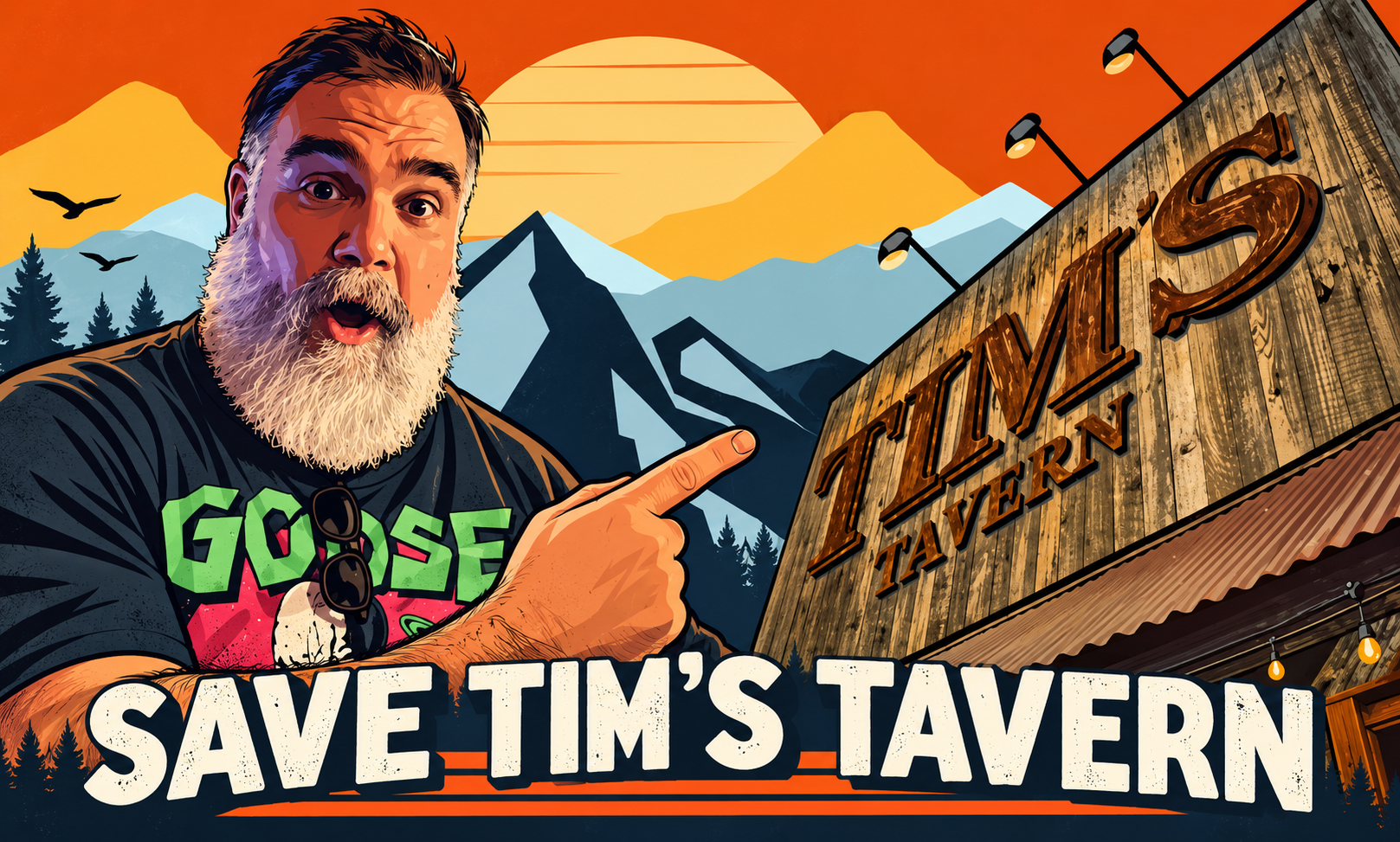
So he went public. The Save TIM’s campaign, under the banner “Live Music Is Not A Crime,” collected 1,500 signatures in its first 24 hours and 1,200 more after that. The county softened, into a path forward that costs real money: demolish the outdoor stage, add an emergency exit, move the fence, hire a licensed arborist to plant native vegetation, and probably lose the patio roof. Reed’s summary: “Unfortunately, we inherited a mess.”
Then winter. A concrete pipe under the neighboring lot gave way, a $25,000 plumbing problem. A windstorm removed the Tim’s sign in installments over four nights. By February he’d sunk $150,000 into bringing the building up to county standards, with $100,000 still to go for tearing down a stage he never built. With two-thirds of his service area unusable, 2025 cost him a quarter million dollars. The temporary use permit that would allow up to 60 outdoor shows a season costs over $10,000, takes six to twelve months of noise and traffic studies and a public hearing, and even then the county decides how many shows he actually gets. Outdoor music at Tim’s is now penciled in for summer 2027. His lease runs two more years.
His words, to Post Alley: “I am not a roll-over-and-die kind of guy.”
Last chance, first stage

Now the part where a screenwriter seems to have gotten involved. Slim’s Last Chance, the Georgetown chili shack and roadhouse with a Diners, Drive-Ins and Dives credit and more than twenty years of shows, was about to lose its owners. Celeste and Michael Lucas, who’d run it for nearly 18 years, were moving to California. They’d heard about Reed’s fight in White Center, so they offered him the building, then the brand, with no money down, because they wanted the music to keep going.
On February 16, 2026, the first Seattle stage Mason Reed ever played became his. The Lucases threw three farewell nights first, and the handover came with existing bookings honored and the long-time staff staying on. His first bill was Jerry Joseph and Wally Ingram five days later. Georgetown, notably, answers to the City of Seattle rather than King County, which Reed notes has clearer rules and plenty of outdoor music. This time he read the contract like a man who’d been burned; the lesson, as he tells it, is to never take a building’s paperwork on faith.
Fixing the whole thing
Most people, having survived all that, would ask for a nap. On September 22, Reed announced the Together in Music Society, a 501(c)(3) built to fix the economics of small rooms outright. Under his model the nonprofit does the booking, hires the bands and guarantees fair pay, while the venue provides the room and sells the food and drinks. Add a gear library, recording and touring grants, free or low-cost legal help for artists, and live music in Sound Transit stations, downtown parks, Pioneer Square and the waterfront. He’s already in talks with Sound Transit and, yes, King County. He’s also seeded the Seattle Legacy Preservation Partnership, a fund to buy venues, cafes and instrument shops before they turn into condos.
Why bother? Because in July both Tim’s and Slim’s lost money on show production and Reed covered the difference out of his own pocket. Small rooms are the minor leagues that make the majors possible, and right now the minor leagues run on the owner’s credit card. “I’m not looking to buy a Lambo,” he says. What he’s looking for is a Seattle where the next band’s third show has somewhere to happen.
He’ll tell you this is a music town, was one before him, and will be one after him. He’s spent nine years, half a million miles, a pandemic, a sewer line and a small fortune making sure of it. That’s what a local music hero looks like. Not a cape. A guy with a shovel, a permit application, and a booking calendar that never goes blank.
How to help: Go to a show. Tim’s Tavern is at 9655 16th Ave SW in White Center; Slim’s Last Chance is at 5606 1st Ave S in Georgetown. Save TIM’s memberships run $10 to $250 a month at SaveTims.com. The nonprofit is at togetherinmusicsociety.org.