
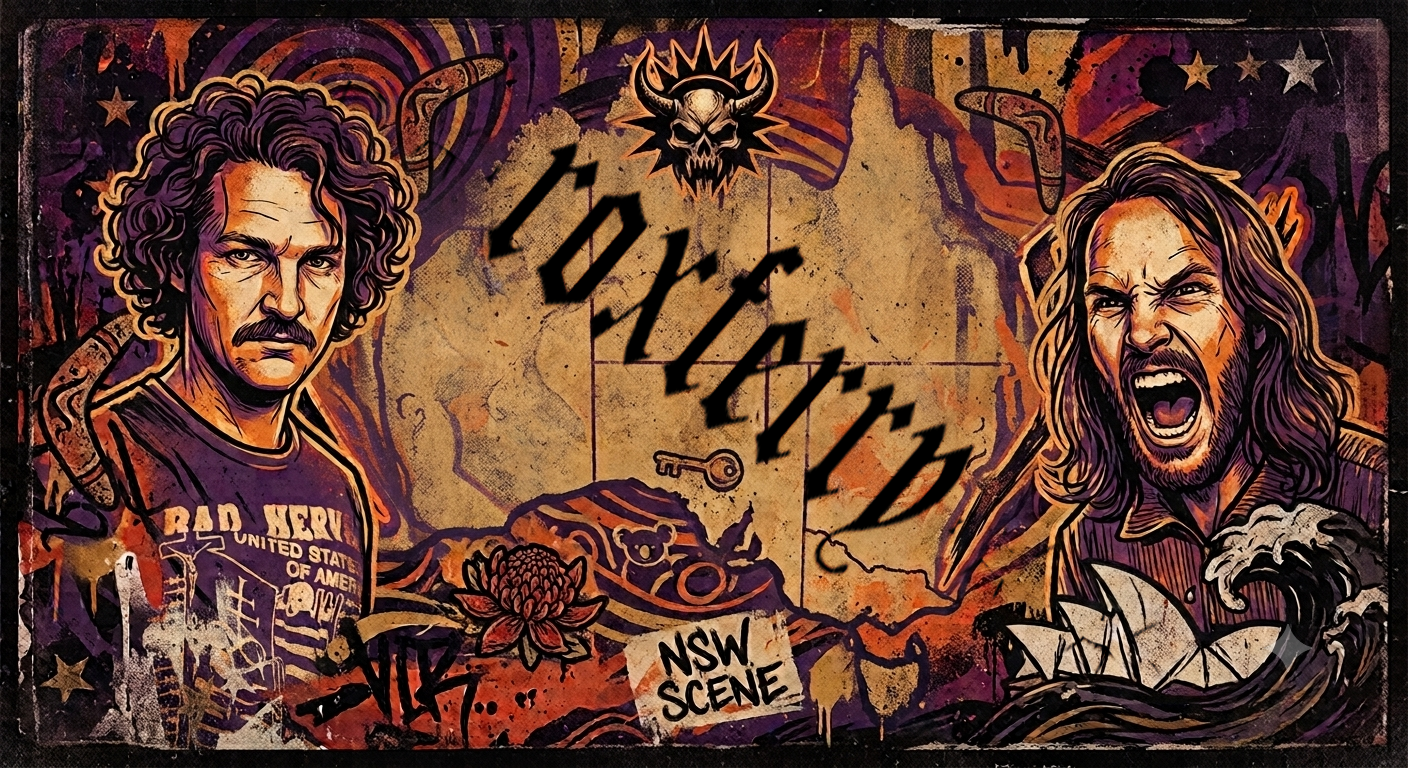
ROXFERRY: HOW THE HELL ARE THERE ONLY TWO OF THEM?
The brothers, the bass, the emotional wreckage—and the difference between a small lineup and a small sound.
There is a question that comes with discovering a band like Roxferry:
Where are they keeping the rest of the band?
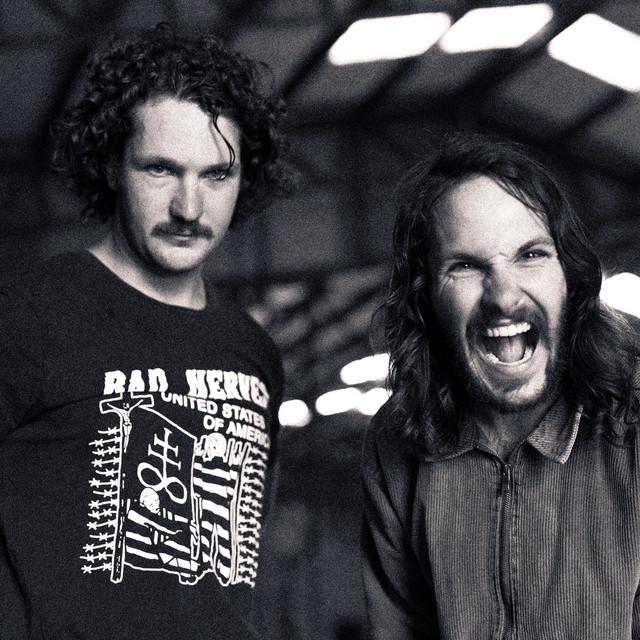
Their official introduction is almost suspiciously straightforward: brothers Clay Teiffel on vocals and bass, and Jake Teiffel on drums, making garage rock out of New South Wales, Australia. Two people. No elaborate personnel list. Their stated influences—Royal Blood, Queens of the Stone Age and Muse—offer some clues, but naming the ingredients does not explain the size of the meal. Roxferry Band
The interesting answer is not simply “effects pedals.”
Roxferry’s two-piece identity describes the people at the centre of the music—not the number of musical functions, sound layers or creative collaborators available to them. Published live coverage points to pitch-processing and additional tracks; recording credits show the brothers doing more than performing; and an orchestral release makes their willingness to expand the palette explicit. The Rockpit
But there is another question underneath the volume: why can the material feel emotionally bigger than the lineup?
For that, we need to get past the equipment and into the writing.
First, though, the investigation turns up an important detail.
1. The first reveal: Roxferry weren’t always a two-piece
Roxferry’s triple j Unearthed biography places their formation in 2018, on the Mid North Coast of New South Wales. That gives them a longer development story than the impression of a duo suddenly materialising in a social-media feed. ABC News
More revealing is the earlier lineup.
In November 2020, Livewire AU’s coverage of “Head On Home” identified Roxferry as Clay Teiffel on vocals and guitar, Jake Teiffel on drums, and Charlie Hull on bass. The band now presented as a bass-and-drums duo was then documented as a guitar-bass-drums trio. Livewireau
That distinction matters. It changes the question from:
How did two people invent a whole band’s worth of sound?
to:
How did a band redistribute the musical jobs when its lineup changed?
The public sources examined here do not establish exactly when or why that transition happened. There is no basis for inventing a falling-out, a manifesto against guitarists, or a grand strategic decision. What is documented is the contrast between Clay’s earlier guitar role and his current official identification as vocalist/bassist. Livewireau
BandCAM’s reading: that history makes the current format more interesting, not less impressive. The duo should not automatically be understood as a conventional rock band with an instrument missing. It may be better understood as a different allocation of responsibilities.
You can remove a position from the lineup without removing every musical function that position once supplied.
2. There is an eyewitness account—and it names the machinery
The strongest published evidence about the live sound comes from Andrew Slaidins’ review of Roxferry at Max Watts in Melbourne on May 16, 2025, opening a bill with Dead City Ruins and Southern River Band.
Slaidins specifically reported harmonisers, octave shifters and accompanying tracks. He also suggested loops, but explicitly presented that part as his assumption. That distinction is worth preserving: this is an eyewitness review, not a verified pedalboard inventory or a technical interview. The Rockpit
So we have a meaningful answer, but not licence to invent a signal chain.
The account supports the idea that the live presentation is expanded beyond untreated instruments. It does not establish particular pedal models, the contents of any playback tracks, how those tracks are triggered, or whether the same setup is used at every show.
There is also a useful clue from the band itself: an August 2026 short on Roxferry’s own channel is titled “Bass VI slaps.” That places the Bass VI in their public musical vocabulary, although a short’s title does not prove which instrument or tuning appears on every recording. YouTube
Why does that matter?
Because a Bass VI occupies a particularly useful intersection. Fender describes it as a six-string bass, normally tuned E–A–D–G–B–E one octave below a standard guitar, with a 30-inch scale. It is not simply another name for a baritone guitar. Fender
That layout offers guitar-like fingering relationships in a bass register. As a musical possibility, it helps explain how one player can move between low-end foundation and more guitar-like riff or chord thinking.
The important unit is not “one instrument.” It is “how many jobs can this instrument perform?”
3. How one played part can become a much bigger sound
Here is the technical explanation without turning the feature into a pedal catalogue.
These are established mechanisms that help explain the reported effects—not a claim that the following products are on Roxferry’s board.
Octaves: the same idea, in more than one register
An octave effect produces a version of a played note higher or lower in pitch. With the original signal retained, one performance can supply a low foundation and a higher, more cutting voice.
BOSS’s octave-pedal documentation illustrates both octave-up/down processing and the ability to send the original and processed signals to different destinations. The musical consequence is straightforward: a single riff can occupy more than one register at once. BOSS
Imagine the low version providing the weight while the higher version supplies the edge you might otherwise associate with another instrument.
That is not an independently thinking second musician. It is an expanded version of the same performance—which can also make the layers feel tightly connected.
Harmonisers: more than a higher copy
A harmoniser can add a different musical interval, such as a third or fifth, rather than simply reproducing the same note an octave away. BOSS’s harmoniser documentation describes additional harmony voices and detuning options. BOSS
The distinction is useful:
Octave processing can increase range and weight. Harmonising can add another pitch relationship.
Neither automatically produces a good arrangement. A bad musical idea with two added voices remains a bad musical idea with two added voices.
But these tools make the assumption “one string player must equal one narrow part” unreliable.
Clean weight and distorted bite can coexist
Another established technique is to retain an unprocessed bass signal while blending it with distortion or fuzz. Electro-Harmonix’s bass-fuzz documentation explicitly describes dry-signal blending and a separate dry output. EHX
Think of that as giving different versions of a performance different duties: one preserves the foundation; another supplies aggression and texture.
Again, that is an explanation of what is technically possible, not confirmation of Roxferry’s precise routing.
Taken together, these mechanisms answer a substantial part of the apparent mystery. Two people do not necessarily produce only two simple sound sources. The relationship between a hand movement and what emerges from the speakers can be considerably more elaborate.
But equipment is only the capacity. Someone still has to decide what the song needs.
4. Stop treating the drummer as the accompaniment
The temptation in a huge-sounding duo is to stare at the string player’s feet.
What pedal did that? Where did the other octave come from? Is there a second amplifier?
That curiosity can accidentally reduce the drummer to a supporting role in an equipment demonstration.
The Melbourne review does not describe Jake that way. Slaidins singled out his driving contribution and visible enjoyment, alongside Clay’s riffs, grooves and vocal melodies. The account presents a performance partnership, not a clever bass setup with drums attached. The Rockpit
For understanding a format like this, I would listen less for “How busy is the drummer?” and more for three decisions:
What does he reinforce? What does he leave open? What makes the next entrance feel bigger?
Those are arrangement questions. They matter more than counting fills.
A useful thought experiment: take one riff and imagine it under a restrained beat, then under a more open, emphatic drum part. The notes of the riff need not change for the section to acquire a different dramatic role.
That is why explaining a duo entirely through pitch-shifting misses the musical point. A processor can generate another note. It cannot, on its own, decide whether this is the moment to hold back or hit harder.
And being brothers should not become a lazy substitute for explaining musicianship. “Sibling telepathy” is an attractive headline. It is not a technical explanation.
5. “Deep” is not just another word for “low”
This is where the question becomes more interesting than a rig rundown.
There are at least three different things a listener might mean by depth: physical weight, an arrangement with several layers, and emotional complexity.
The equipment discussion addresses the first two. The lyrics offer evidence for the third.
“Sly”: the accusation does not protect the narrator
The lyrics published on Roxferry’s own Bandcamp page place “Sly” in a landscape of deception, abandoned commitments and damage that persists after a relationship has supposedly ended.
My reading is that the crucial movement is from accusation toward exposed hurt. The narrator can identify betrayal and condemn the other person, but cannot simply remove their emotional presence. Anger does not resolve attachment. The imagery of injury becomes a way of admitting that separation has not produced recovery. Roxferry
That is more involving than uninterrupted swagger.
The narrator is not merely powerful, furious and correct. There is a gap between what they want to declare and what they can actually stop feeling.
That gap is where a song can acquire emotional depth without requiring an elaborate plot.
“DROWN”: recognising the danger is not the same as escaping it
The published lyrics of “DROWN,” credited to Clay, offer a related contradiction. The narrator describes being diminished by an attachment while continuing to want the person associated with it.
My interpretation is that the song’s tension comes from desire and self-preservation pulling in different directions. The repeated movement through wanting, taking and leaving does not read as a clean resolution. It suggests someone caught in a cycle they can articulate without necessarily breaking. Shazam
These are readings of song narrators—not claims about the brothers’ private lives.
That boundary matters. Lyrics are not sworn autobiographical statements.
Nevertheless, there is a persuasive answer here to “How can a two-piece be so deep?”
Because emotional complexity does not require a large cast. One voice expressing two incompatible needs can contain more drama than a room full of uncomplicated declarations.
6. The recording credits reveal more than two performers
The credits for “Do It Again” identify Clay on electric bass and Jake on drums. They also credit both brothers as songwriters and producers. That does not prove nobody else contributed, but it does establish that their involvement extends beyond turning up and playing assigned parts. Shazam
This is another reason headcount is an inadequate explanation.
A person can be the performer, the writer deciding what should happen, and the producer deciding how the listener encounters it. Those are different jobs, even when the same name appears beside them.
Then comes the most revealing expansion of all:
Roxferry released an orchestral version of “Do It Again” on July 25, 2025. The official video credits Oliver Schnee with the string arrangement. Apple Music – Web Player
There goes the idea that “two-piece” must mean an oath against additional instrumentation.
The release is evidence of a band willing to let a song exist outside its core lineup’s immediate vocabulary. It also makes collaboration visible rather than leaving listeners to speculate about how every sound appeared.
I would not treat the existence of an orchestral version as automatic proof of compositional greatness. Strings are not a certificate of seriousness.
It is, however, a particularly useful comparison to make: what remains recognisably the song when its instrumental surroundings change?
That question gets closer to artistic identity than asking whether a band has “cheated” by allowing more than two things into a recording.
A band is a creative unit, not a restriction on the number of tracks in a session.
7. The evidence trail: where to enter the catalogue
Rather than prescribe a dubious definitive ranking, here is a route through the material that tests different parts of the two-piece question.
| Stop | What it contributes to the investigation |
|---|---|
| “Head On Home” — 2020 | The historical reference point: contemporary coverage documents the earlier three-member lineup. Useful for separating the band’s origins from its present identity. Livewireau |
| “Sly” — 2023 | Start here for the relationship between confrontation and unresolved hurt. The band’s own page provides the lyrics as well as the recording. Roxferry |
| “BITTER,” “LOOSE” and bleached. — 2024 | A cluster worth exploring between the earlier material and the 2025 releases. Apple’s catalogue identifies all three in the 2024 period. Apple Music – Web Player |
| “Do It Again,” then its orchestral version — 2025 | The most direct comparison for examining the distinction between the song and its instrumentation. Put the versions next to each other rather than treating the alternate arrangement as a novelty. Shazam |
| PRETEND EP — August 14, 2026 | Five tracks—“PRETEND,” “BLINDED,” “CYANIDE,” “CAGE” and “DROWN”—in approximately 16 minutes. A compact recent body of work, rather than a single isolated clip. Apple Music – Web Player |
| “HANGNAILS” — September 18, 2026 | The newest release shown on Apple Music at the time of this report. It brings the investigation up to the current catalogue rather than stopping at older promotional material. Apple Music – Web Player |
While listening, the useful exercise is to stop asking only how much sound there is.
Ask which element carries the weight at each moment. Ask whether a returning section feels bigger because something was added—or because something was withheld beforehand. Ask whether the vocal is simply reinforcing the riff’s attitude or introducing a conflicting emotion.
Those questions distinguish arrangement from accumulation.
More layers can make a recording denser. They do not necessarily make it deeper.
8. What we can establish—and what still needs a proper rig interview
There is enough evidence to reject the simplistic explanation that this is merely two untreated instruments played exceptionally loudly.
There is not enough to publish an authoritative, song-by-song diagram of their current live setup.
The unresolved technical questions are specific: Where does Clay’s signal split? Which effects create which voices? What additional material is played back live, and how is it controlled? The historical question is equally specific: when did the trio become the duo, and how did that alter their writing?
There is already a substantial interview lead. Paul Misko’s Riff Tacos episode 37, published August 18, 2025, features Roxferry in a conversation advertised as covering riffs, songwriting, gear and their approach to going viral. Its listed duration is 76 minutes. The episode description is accessible; a usable transcript was not available in the material retrieved for this report, so its contents have not been presented here as verified answers. Spotify for Creators
That distinction prevents a research feature from quietly turning a promising interview title into invented testimony.
It also keeps the next investigation focused. We do not need another generic question about influences. We need the brothers to walk through the musical decisions behind the machinery.
The BandCAM verdict
The mistake is counting people when we should be counting responsibilities.
The evidence points to a small core capable of working across performance, writing and production, with a live sound described as technologically expanded and a recorded catalogue open to outside arrangement. Meanwhile, the published lyrics give us narrators whose anger does not cancel their vulnerability. Shazam
That is the stronger explanation of “deep”: not one secret pedal, and not a mystical property of being brothers, but several kinds of work happening inside a compact identity.
The technical tools can explain how a sound becomes larger. They cannot fully explain why somebody cares about it.
That part lives in the choices: what to reinforce, what to leave exposed, what to repeat, and what emotional contradiction refuses to go away.
Two people. More than two jobs. The headcount was never the whole story.